The first year of HEC in Lausanne
Welcome to HEC Lausanne! You're now in one of the best business schools in the country! This reputation naturally comes with a heavy workload, especially in the first year. But don't worry: I'm going to give you the keys to pass it with peace of mind. Beyond the courses, you'll discover a rich and exciting student life. Between events of all kinds (parties!!), workshops, and the many associations, you're sure to find something you like.
1. General presentation
The number of first-year students keeps increasing over the years: around 800 a few years ago to nearly 1,000 now. This increase has prompted the faculty to broadcast the lectures online, at least during the first semester.
Unfortunately, about 60% of students do not move on to the second year… But that does not mean they all failed. Some of them simply choose to stop, because the training does not suit them. Having discussed it with some friends in this situation, many confided in me that they did not expect so many quantitative subjects (maths I and II, stats I and II,...)
2. Programme of the year
Since 2023, with the reform that was introduced, the subjects have been grouped into so-called 'propaedeutic' modules, which aim to give you the necessary foundations for the following years. In hindsight, these modules proved very useful for understanding the more advanced courses afterwards. I'm going to explain their content as well as how it generally works, so that you can meet all the conditions needed to pass your year.
Module 1:
-
Economics I: This first course introduces the basics of microeconomics, that is, the study of how individuals and firms behave when faced with decisions about production, consumption and exchange. You will discover how a market works, how prices form through supply and demand, and the main theorems of social welfare. The aim is to understand the fundamental economic mechanisms and to acquire the tools needed to analyse them.
Organisation: You will have two lecture periods, an exercise correction session, as well as office hours during which the assistants are available to answer your questions. There are therefore many opportunities to help you!
My opinion: The course is neither the most difficult nor the one that requires the most work, but you need to master the essential concepts well and be precise in the exam, because points can be lost quickly. Prof. Gallea is top-notch and you will see him again in the following years.
-
Mathematics I: Before explaining what you will learn in this course (and this is not to spoil the mood), it is one of the subjects with the highest failure rate. These are the results for the 2023 cohort.
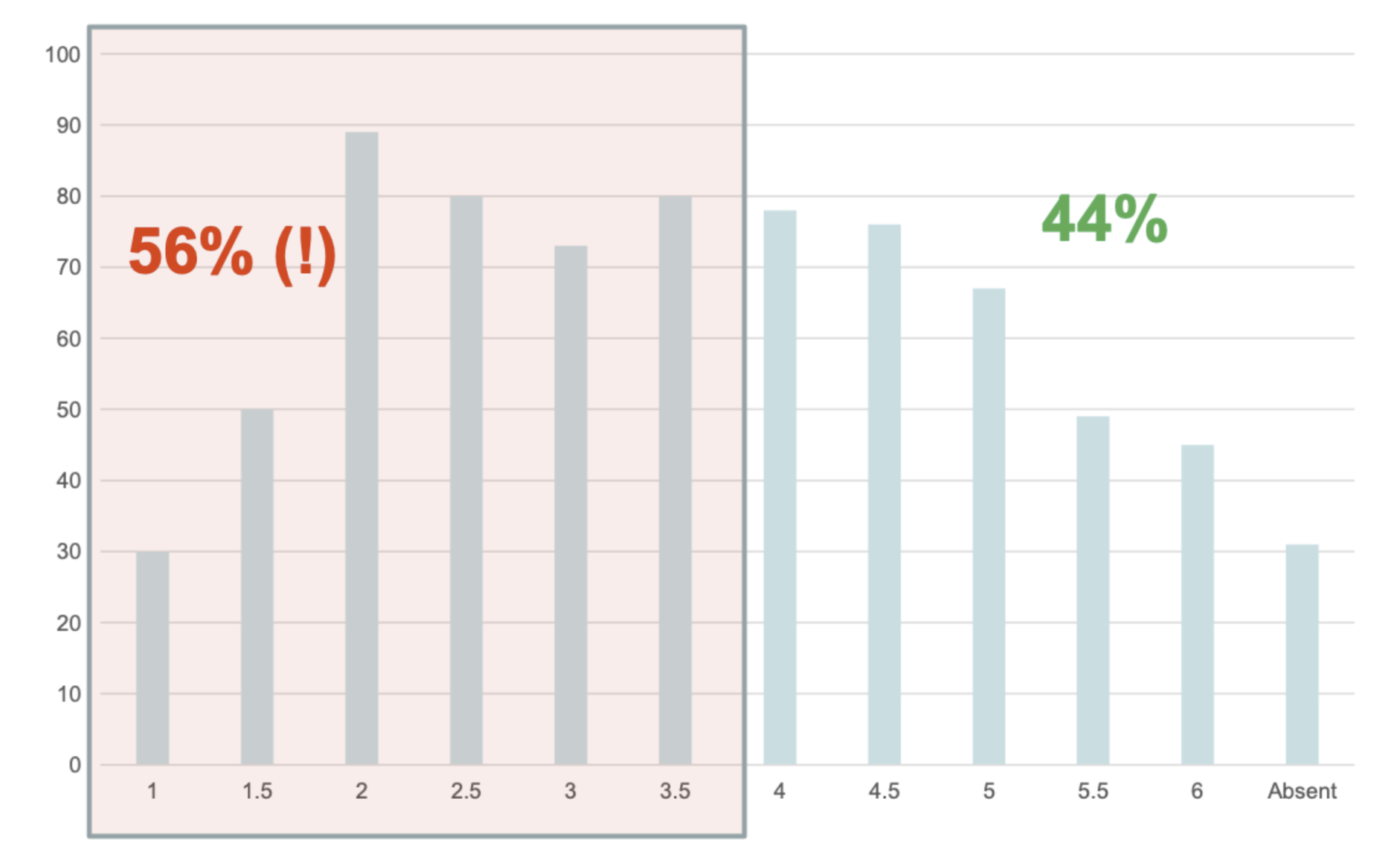 Let us now turn to the Maths I program: broadly speaking, you will study financial mathematics in parallel, with concepts such as the rate of return, loan repayment, how bonds work, and much more, as well as a section devoted to mathematical analysis, covering in particular derivatives, differential equations, and their main economic applications.
An intermediate test takes place around mid-November: it counts for 30% of the semester grade if you get a better grade there than in the January exam. Few students (myself included…) really take it seriously, whereas it can clearly make the difference, especially since the material is only half covered at this stage.Organisation: the course runs as follows: 4 teaching periods per week, plus a “LABOS” session in which the teaching assistants are there to help you work through the exercise sets and answer your questions. Every week an exercise session is offered: part of it is corrected in class with the lecturer, while the rest is worked through in detail on Moodle.
My opinion: It's one of the courses where I really made the effort to be disciplined during the classes and by working regularly on the exercise series. I didn't often go to the LABS, but they are frankly useful for keeping the pace and asking your questions directly while working on the exercises.
-
Statistics: In my view this is one of the most useful courses of the first semester (and also one of the most interesting, though that is personal), because it introduces you to key concepts that will serve you in the following years. You will of course cover probability in its various forms, but also hypothesis testing, tools that are both practical and concrete and whose usefulness shows up easily in everyday life.
Organisation: 4 class periods, one exercise correction and finally office hours.
My opinion: As I mentioned above, I enjoyed this course because it offered many concrete examples. On the other hand, some parts, which were more theoretical, seemed less useful to me, especially when you look at the exam format. I found the professors' teaching to be of particularly good quality.
Module 2:

-
Financial accounting: In this course you will learn the basics of accounting: reading and preparing a company's main financial statements — the balance sheet, the income statement and the cash flow statement. At the end of the semester you will receive the financial documents of a company to analyse, and part of the exam will be based on them.
Organisation: 4 class periods and one hour of office hours with assistants each week.
My opinion: The course is well done: over the semester, the concepts that allow you to understand (or at least try to understand) a company's accounts are added little by little. I found it really practical.
-
Intro to management and business ethics: Thought you were done with Aristotle, Kant or Sartre? Well, no! Here you will tackle some of the great concepts of ethical management (from a very, very long way off…), starting from existential questions and arriving at slightly more concrete theories that you will go deeper into in the following years.
Organisation: 2 hours of class each week.
My opinion: Even if the course can sometimes go a bit all over the place, it has the merit of taking you out of the daily routine full of numbers and making you think differently. I advise you to do the quizzes offered each week, in addition to ours, because you probably won't feel like getting into it during the revisions (even if the subject is interesting) and it can really save your module!
-
Computer models (SQL): The course starts with the basics of computing — the structure and workings of a computer — before moving on to the standardised SQL language, which lets you create and manipulate databases.
Organisation: 4 class periods each week.
My opinion: I strongly advise you to do the lab sessions offered every week: they're not complicated and let you earn between 0.25 and 0.5 point (grade) on the final exam depending on the quality of your work and the number of submissions.
Module 3:

-
Economics II: The first part of the course is still devoted to microeconomics, while the second gets to the heart of the matter with macroeconomics, which looks at the actions taken by governments and countries to influence the economy as a whole. You will also discover the basics of the economic models that will accompany you in the following years to analyse economic phenomena and policies.
Organisation: 4 class periods, one exercise correction and finally office hours each week!
My opinion: This is one of my favourite courses at HEC in this first year, because it helps you understand certain economic realities as well as the workings and consequences of policies you often hear about in the media. I enjoyed the “energetic” teaching of Professor Houde, who gives the first part of the course.
-
Mathematics II: This second part of the mathematics course covers linear algebra, where you will work on vectors, matrices and systems of linear equations, among other things. Several notions have applications in political economy, which makes them easier to grasp thanks to the links between the courses.
Organisation: Same as in the first semester, with “LABOS” sessions
My opinion: The subject may seem a bit simpler, but beware of surprise exercises in the exam. So I advise you to stay regular, to do the exercise series every week and to practise on the old exams.
-
Regression and causal analysis: Called “Stat II” before the 2023 reform, this course covers concepts that are fundamental in statistics and econometrics: simple and multiple regression, and causal analysis. The first lets you study the relationships between variables, explain certain phenomena and make predictions, while the second seeks to identify cause-and-effect links between those variables.
Organisation: 2 class periods and one period for correcting exercises.
My opinion: The course is very practice-oriented, with examples drawn from real studies, which makes learning concrete and particularly interesting to understand. The workload is not to be compared with that of Stat I but be careful not to neglect it!
Module 4:

-
Organisational behaviour: You explore various theories about behaviour in an industrial setting, whether to understand how leadership works or the factors that influence performance at work.
Organisation: A short 2 hours of class per week.
My opinion: it is a fairly interesting course, because it leads you to reflect on how companies work, both on their positive aspects and on their limits as well as on their management. You will be allowed a double-sided sheet of notes; I advise you to prepare it as you go along to avoid an overload during revision. Special mention to Professor Bastardoz, who makes you want to come and listen to the lecture.
-
Business law: The content of this 6-credit course splits into two parts: a general part and a special part. The first presents the foundations of Swiss law and how the country's political system works overall, while the second focuses on the obligations arising from contracts and other legal ties.
Organisation: 4 hours of class and office hours with the teaching assistants.
My opinion: an interesting course that lets you become familiar with the basics of law, useful both in the fields of economics and management and in everyday life.
-
Introduction to programming (python): On the same principle as the "computer models" course of the first semester, this is an introduction to one of the most well-known and used programming languages: Python.
Organisation: same as in the first semester, 4 hours of classes per week
My opinion: you should try to do the exercises proposed in class on your own and ask the assistants for help if needed, without going straight to AI, which is often (too) good at this kind of problem. There are also assignments to hand in each week, which can earn you a bonus of up to 0.5 point added to your final grade.
Module 5:

- English for communicating: For this first course you will be in a small group for two hours, every other week. It is a chance to broaden your vocabulary in connection with your studies, both spoken and written. I found being in a small group rather pleasant, because it makes exchanges easier and lets you build connections with other students more readily — contact is far easier than in a lecture hall.
- Introduction to sustainability: This course takes place in weeks 1 and 8 of each semester, with activities or assignments to complete between the two sessions. I found it particularly interesting, because it helps you understand each of the planetary boundaries and see where we stand today in relation to those challenges.
3. The promotion criteria
I'm now going to explain the conditions to meet in order to pass your year. To start with, all the modules I told you about are MAMs, that is, modules with an average of compulsory teaching units, basically, all the courses are compulsory.
Next, each of the 5 modules is independent of the others. For example, you can pass module 1.1 but fail 1.3. In that case, you'd be in simple failure (I'll explain what that means right after).
To validate a module, you must obtain a weighted average (according to the ECTS credits of each course of the module) greater than or equal to 4.0.
Let's take an example with module 1.1, if you have 3.5 in Maths I (6 ECTS), 4.0 in Statistics (6 ECTS) and 5.0 in Economics I (3 ECTS), then your weighted average for this module will be 4.0, which allows you to validate it.
If you ever fail to validate a module, you will, as I said earlier, be in simple failure. At that point, two options are available to you to make up for it: go to the resit (which takes place in August-September), or repeat the year. You cannot do both, because you are entitled to a maximum of two attempts per course (except in exceptional cases).
In both cases, you only retake the subjects you failed. You can't choose other courses from the module to compensate for your grade (yep, it's a shame :/)
Unfortunately, if you fail both attempts (which I do not wish for you!) you will end up in definitive failure and will therefore no longer be able to try your luck.
4. Working methods and tools
As for the working method, you really need to find the one that suits you best. Easier said than done, I know, but it is by testing different approaches that you will eventually find what works for you.
Personally I have no “magic” method, but what really helped me was being well organised. On one side, I prioritised my courses by writing myself a small plan with precise tasks, rather than just sitting down and working on instinct. On the other, I tried to stay on top of all the important information (submission dates and so on) and I tidied up my course folders so as not to get lost in them.
As for equipment, personally I just had a laptop and paper, and honestly that was more than enough. Quite a few students had an iPad, which is super handy to have everything in one place, but it's not essential.
If you have no equipment to start university and you are considering a purchase, I would perhaps advise a tablet, because it's a good compromise.
But if you already have a computer, paper will do the job just fine provided you are well organised so as not to lose track with loose sheets.
5. Student life
Student life at HEC is super rich! Whether you feel like getting involved in an association or just taking part in their events, there's bound to be something for you. Whatever drives you, you'll surely find an association that suits you: between the committee that organises the year's big events and sells stuff (lecture notes, books, etc.), the entrepreneurship and investment associations, the sports clubs, and plenty of others, there's really plenty to do. If you're motivated, I advise you to go take a look at their info sessions, and don't worry: they'll also come to introduce themselves at the start of the year during class! I'll remind you that there's obviously no obligation, the goal is just to inform you about the different ways of getting involved in student life. It can seem a bit stressful at first, especially when you're starting fairly demanding studies, so don't put pressure on yourself: nothing obliges you to get involved from the first year. You'll still have plenty of opportunities throughout your studies. And even without being part of an association, you can absolutely take part in their events! There's something for every taste: conferences, workshops, weekends, the Ball, and of course the unmissable parties!
6. Tips and personal experience
I've already shared the few tips I had in each course, but if I had to sum up, I'd say it's really essential that you find a regular working rhythm, with a certain discipline. Of course, it will all depend on how easy you find the subjects over the year, but by working consistently, doing the series and going back over the old exams, you'll clearly put the maximum chances on your side. Another point I wanted to raise with you concerns what some students may say, along the lines of: 'I know someone who did nothing all year and still passed.' I don't know any, and if there are some, they're often exceptions. The most important thing is that you focus on yourself. Move forward at your own pace, take the time to understand the concepts, because in the end, it's you who will be facing the exam.
Let us now turn to the holidays. Unfortunately, you can forget about a long winter break. Even if some manage to free up several days in a row, it remains quite rare to have a real holiday at that time. Once again, it all comes down to consistency during the semester: by working steadily, you can reduce the pressure and allow yourself a little respite from time to time, without feeling guilty. After the January session, you will be entitled to at least two weeks of rest; the length will depend on the date of your last exam.